Understand Your Stress Patterns. See What Reduces Them.
You feel stressed, but you don't know why. Is it the 3 cups of coffee? The meeting-heavy schedule? Poor sleep? Lack of exercise? Your commute? Without data, you're guessing. ReactLog correlates your perceived stress with sleep, caffeine, exercise, work patterns, diet, and lifestyle—revealing what actually drives your stress and what reduces it.
Stress Management Without Data Is Just Guessing
Americans are more stressed than ever. Work pressure, financial anxiety, social obligations, health concerns—the sources are endless. You know you're stressed, but you don't know how to fix it because you don't understand what's actually driving it.
Most stress management advice is generic: "exercise more," "sleep better," "meditate," "reduce caffeine." But you don't know which interventions work for you specifically. Maybe exercise reduces your stress by 30%. Maybe eliminating caffeine does nothing. Maybe your real problem is too many meetings, not coffee. Without tracking, you're implementing random lifestyle changes and hoping something sticks.
The bigger problem is you can't see patterns in your stress. You might be calm on Monday and anxious on Wednesday, but you don't connect it to Monday's good sleep or Wednesday's back-to-back meetings. Your stress might spike predictably on days with a certain person, situation, or schedule—but you never notice the correlation. So you keep repeating the same patterns that stress you out.
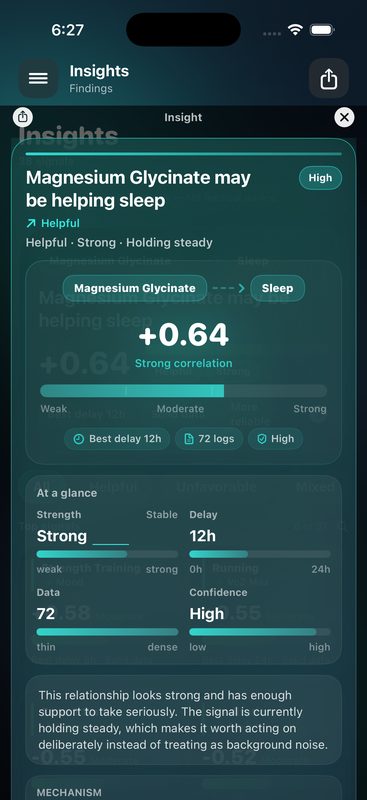
The solution is data. Track your perceived stress level daily alongside your sleep, caffeine intake, exercise, work schedule, diet, and any other factors you think matter. After 2-3 weeks, ReactLog detects the correlations: "Your stress is 35% higher on days with 4+ meetings and poor sleep," or "Your stress drops 40% on days you exercise." Now you have evidence about what actually works for you.
How It Works in 3 Steps
Transform stress guessing into evidence-based stress management.
Log Your Stress Level
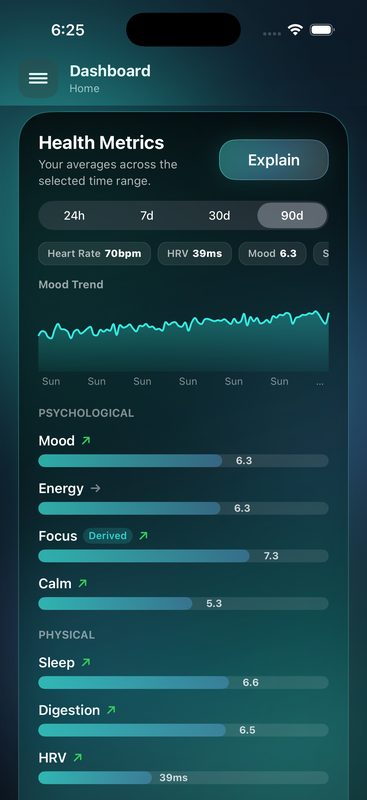
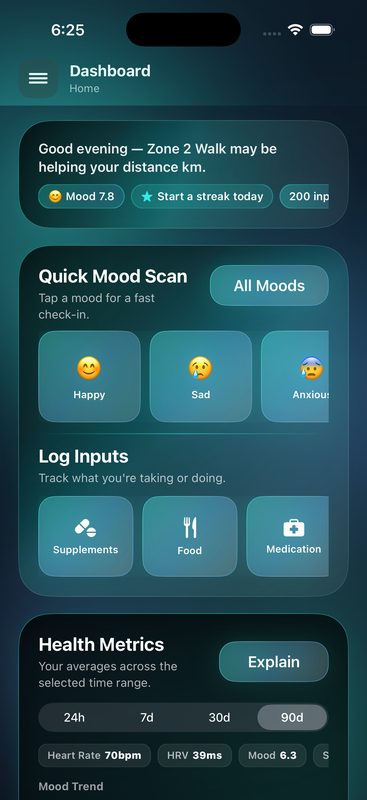
Rate your stress and mood multiple times throughout the day—morning, midday, and evening at minimum. Each check-in takes 10 seconds on a simple slider. The more often you log, the more precisely ReactLog can map your stress patterns and connect peaks to specific triggers. A single daily entry misses the peaks and valleys that reveal the real story.
Track Your Factors
Log your daily inputs—sleep, caffeine, exercise, work meetings, diet, social interactions—and combine them with your frequent stress and mood check-ins. These two data streams are what power ReactLog's correlation engine. Quick sliders and toggles make each entry frictionless.
See Your Stress Drivers
After 2-3 weeks of consistent logging, ReactLog's on-device analytics surface patterns: "Your stress is 40% higher on days with 3+ meetings" or "Stress drops 30% when you sleep 8+ hours." You discover exactly what reduces your stress and what makes it worse.
Track Everything That Affects Your Stress
ReactLog adapts to your unique stress profile. Track any combination of these:
Perceived Stress
Daily stress level rating, anxiety, and emotional state
Sleep Quality
Sleep duration, quality, wake-ups, and morning alertness
Caffeine Intake
Coffee, tea, energy drinks, and timing—see how caffeine affects stress
Exercise & Activity
Type, duration, intensity, and how it impacts your stress levels
Work Schedule
Meetings, deadlines, work type, and work hours—identify what stresses you
Diet & Nutrition
Meals, alcohol, sugar, and diet quality—track how food affects stress
Physical Symptoms
Headaches, tension, anxiety, digestive issues, or any stress-related symptom
Custom Factors
Social interactions, weather, relationships, or any custom metric
Your Stress Data Stays on Your Phone
Why privacy matters when tracking stress and cortisol.
Your stress levels and what triggers them reveal deeply personal information: work challenges, relationship issues, health anxieties, financial pressures. You don't want that data on someone else's servers where it could be sold, hacked, or used against you.
Traditional health apps monetize your data. They track your stress patterns, sell the data to insurance companies or advertisers, or claim they've encrypted it while still analyzing it on their servers. ReactLog takes a completely different approach:
- No backend servers — Your stress data lives on your device only. Period. No servers means nothing to hack.
- No analytics tracking — We don't send telemetry about your stress levels, usage patterns, or any personal information.
- No data collection — We have nothing to collect because all processing happens on your phone.
- No account required — You don't create a login or give us your email. You're anonymous to us.
- Face ID/Touch ID lock — Your stress data is biometrically protected on your phone for an extra layer of security.
We charge for the app instead of charging you with your privacy. This aligns our interests with yours perfectly. We want you to track your stress in our app, but we don't want or need your data. You have complete control.
Frequently Asked Questions
How can tracking my stress help me manage it?
By logging your perceived stress level alongside your daily activities, you discover what actually triggers your stress and what reduces it. ReactLog automatically detects patterns—for example: "Your stress is 40% higher on days with 3+ meetings" or "Your stress drops 30% when you exercise and sleep 8+ hours." This data-driven insight lets you make targeted lifestyle changes that actually work for you.
What stress symptoms can I track?
Track any stress-related symptom: anxiety, tension, headaches, chest tightness, muscle pain, jaw clenching, insomnia, digestive issues, brain fog, irritability, fatigue, or any custom symptom you experience. ReactLog lets you create unlimited custom metrics unique to your stress response. You identify which physical and emotional symptoms correlate with which stressors.
How does cortisol tracking work without a wearable?
ReactLog correlates your perceived stress levels, sleep patterns, caffeine intake, exercise, and work schedule to identify what's driving your cortisol and stress response. You track subjective markers (how stressed you feel, your symptoms) and behavioral inputs (sleep, caffeine, exercise, work schedule), and ReactLog's on-device analytics find the correlations. After 2-3 weeks, patterns emerge about what reduces your stress most effectively.
How long does it take to see stress patterns?
Most users begin seeing meaningful patterns after 2-3 weeks of consistent daily tracking. Some discover clear triggers within 10-14 days if they track consistently. The more data you log, the more confident the patterns become. Consistency matters more than duration—tracking every day gives you better insights than sporadic entries over several months.
Is my stress and cortisol data private?
Yes, absolutely. ReactLog has no backend servers and zero data collection. Your stress logs, cortisol observations, symptoms, and all tracked data never leave your iPhone. We use on-device processing only. You can lock the app with Face ID or Touch ID for additional security. Your data is completely private and stays on your device.
Start tracking today.
Start your 14-day free trial. No account required. Your stress data stays on your phone.