See How Your Sleep Affects Your Mood
Your sleep quality and duration profoundly shape how you feel the next day. But most people don't track the connection. You might sleep poorly and blame stress, when the real culprit is just 5 hours of broken sleep. ReactLog reveals the bidirectional relationship between sleep and mood—showing exactly how hours slept, sleep quality, and wake-ups correlate with your daily emotional state, energy, and outlook.
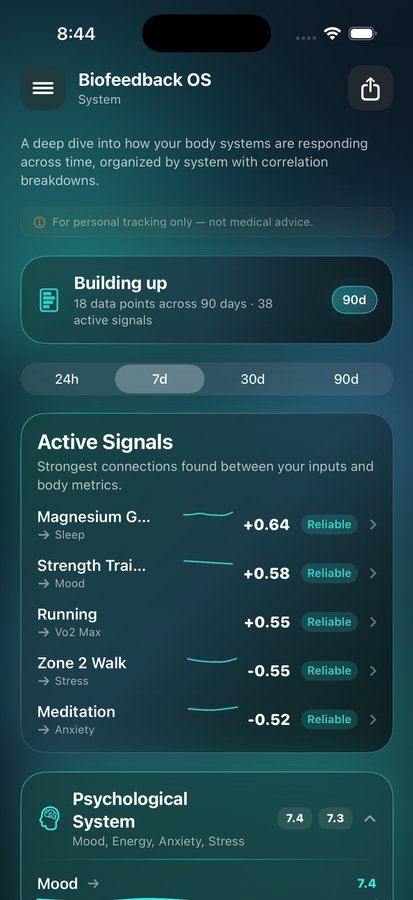
Poor Sleep and Low Mood Are Often Linked—But You Can't See the Pattern
You know intuitively that sleep affects mood. You've felt the irritability and emotional fragility that comes from a bad night's sleep. Yet most people don't systematically track this relationship, so the connection remains invisible. You can't quantify it, can't prove it to yourself, and can't use it to improve your life.
The result is a vicious cycle: Poor sleep tanks your mood. Bad mood disrupts sleep the next night. The cycle deepens. Without data, you're trapped in patterns you can't see or break. You attribute your low mood to circumstances ("work is stressful," "life is hard") when the root cause might be that you've been sleeping 5-6 hours for three weeks straight.
Sleep deprivation doesn't just make you tired—it impairs emotional regulation, increases anxiety, and warps your perspective. Research shows that even one night of poor sleep reduces your mood by an average of 15-20%. Over a week of bad sleep, the cumulative effect is profound. Yet because the connection happens gradually, you might not notice it until you're deep in a depressive episode.
The solution is to track both simultaneously and see the correlation. Log your sleep duration, quality, and wake-ups. Rate your mood, energy, and emotional state daily. After 3-4 weeks, patterns emerge: "My mood scores are 35% higher on mornings after 8-hour sleep nights." Once you see the data, you can break the cycle. Better sleep becomes a mood intervention, not just a health habit.
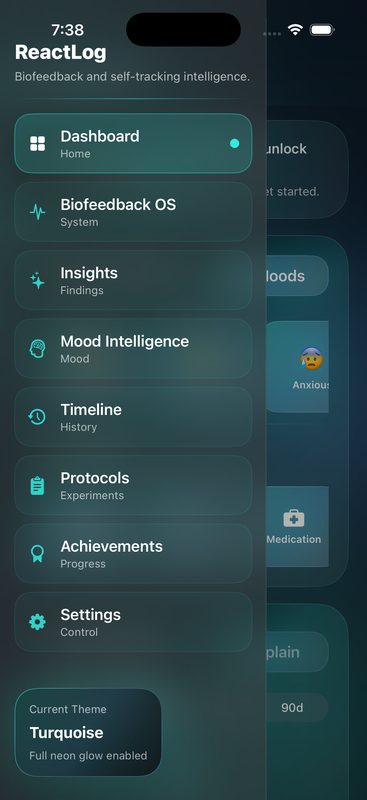
How It Works in 3 Steps
Transform sleep and mood confusion into clear, actionable patterns.
Log Your Sleep
Each morning, record how long you slept, how well you slept, how many times you woke up, and when you fell asleep and woke up. It takes 30 seconds. ReactLog tracks sleep duration, quality, wake-ups, and timing over time.
Rate Your Mood
Check in with your mood multiple times a day—morning, midday, afternoon, and evening. Rate mood, energy, motivation, anxiety, and emotional state on quick sliders. The more often you log, the more data ReactLog has to correlate with your sleep. You'll discover exactly how last night's sleep affects your 2pm energy or your evening mood.
See Sleep-Mood Correlations
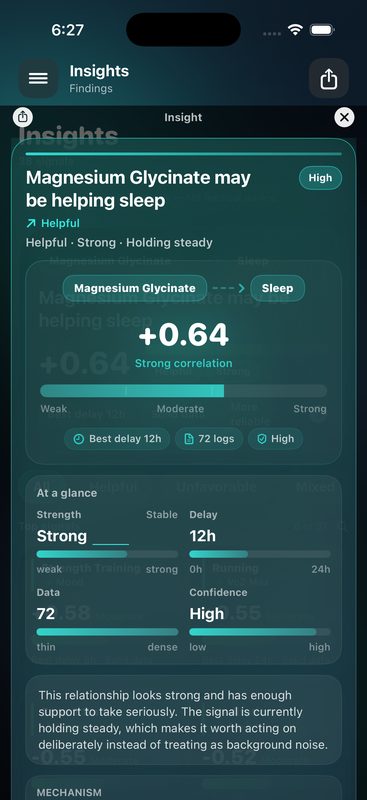
After 2-3 weeks of consistent logging, ReactLog's on-device analytics reveal patterns: "Your mood is 32% higher on days after 7+ hour sleep." You'll see which sleep habits correlate with your best emotional days.
Track What Drives Your Mood and Sleep
ReactLog captures the full picture of your mood-sleep relationship. Track any combination of these:
Daily Mood
Overall mood rating, emotional tone, and subjective well-being throughout the day
Sleep Duration
Total hours slept, sleep timing, and consistency patterns night to night
Sleep Quality
How rested you feel, wake-ups during the night, and morning grogginess rating
Energy Levels
Daily energy rating, fatigue perception, and motivation throughout the day
Mental Clarity
Brain fog rating, focus duration, and cognitive sharpness each day
Stress & Anxiety
Anxiety levels, stress perception, and emotional resilience tracking
Emotional Patterns
Track specific emotions—happiness, sadness, irritability, contentment over time
Custom Mood Metrics
Create unlimited custom tracking for your unique emotional dimensions
Your Mood and Sleep Data Stays on Your Phone
Why privacy matters for intimate emotional tracking.
Your mood patterns and sleep habits reveal deeply personal information about your mental health, emotional struggles, and vulnerabilities. This data is too sensitive to live on someone else's server. You don't want depression patterns, anxiety levels, or sleep struggles monetized by data brokers or sold to insurance companies.
Most health apps sell user data to third parties. Some do it openly; others claim privacy while doing it anyway. ReactLog takes a fundamentally different approach that protects your emotional privacy:
- No backend servers — Your mood and sleep data lives exclusively on your device. Period. No data pipeline, no data collection infrastructure.
- No analytics SDKs — We don't track your usage patterns, mood trends, or behavior. Zero telemetry.
- No data collection — We have nothing to sell, no infrastructure to collect data, no analytics dashboard tracking your patterns.
- No account required — You don't create a login, don't give us an email, don't provide any identifying information. Pure anonymity.
- Biometric protection — Lock your mood journal with Face ID or Touch ID. Your emotional data is physically protected on your phone.
We make money by charging for the app, not by collecting your emotions as a commodity. This creates perfect alignment: your privacy is our business model. We want you to track deeply and honestly because that makes ReactLog better—and we have zero incentive to monetize what you share.
Frequently Asked Questions
How does sleep affect your mood?
Sleep is foundational to emotional regulation. Poor sleep impairs your prefrontal cortex—the brain region responsible for emotional control—making you more irritable, anxious, and prone to rumination. Quality sleep restores this capacity. Research shows that even a single night of poor sleep reduces mood by 15-20%, while consistent 7-9 hour sleep nights boost overall emotional well-being by 30-50%. ReactLog helps you quantify this relationship with your personal data.
What sleep metrics can I track?
Track total sleep duration (hours slept), sleep quality (how rested you feel 1-10), number of wake-ups during the night, time to fall asleep, morning grogginess, bedtime and wake time, and sleep consistency. ReactLog then correlates these metrics with your daily mood, energy, anxiety, and emotional state, revealing which sleep factors matter most to your mood.
How long until I see mood-sleep patterns?
Most users start seeing meaningful sleep-mood correlations after 2-3 weeks of consistent tracking. You might discover patterns like: "My mood is 30% better on mornings after 8-hour sleep nights" or "Days after poor sleep, my anxiety is 25% higher." The more weeks of data you collect, the more confident and detailed these patterns become. Consistency matters more than duration.
Can ReactLog predict mood based on sleep?
Yes. After 4-6 weeks of data, ReactLog's on-device analytics can show predictive patterns. If your historical data consistently shows you're 35% happier after 7+ hour sleep nights, ReactLog highlights this relationship. You'll understand that improving sleep quality becomes a direct mood intervention. You'll also see reverse patterns: low mood can disrupt sleep, creating a bidirectional feedback loop that you can intentionally break.
Is my mood and sleep data private?
Yes, absolutely. ReactLog has no backend servers and zero data collection. Your mood entries, sleep logs, anxiety ratings, and all personal emotional data never leave your iPhone. We use on-device processing only. You can lock the app with Face ID or Touch ID for an additional security layer. Your mood journey is entirely private, known only to you.
Start tracking today.
Start your 14-day free trial. No account needed. Your mood and sleep data stays on your phone.